
When to Rekey vs. Replace Your Locks: Making the Right Choice
One of the most common questions property owners face is whether to rekey or replace their locks. Both options change who can access your property, but they differ in cost, scope, and outcomes. This guide helps you understand the factors to consider when making this decision.
Understanding the Difference
#### Rekeying
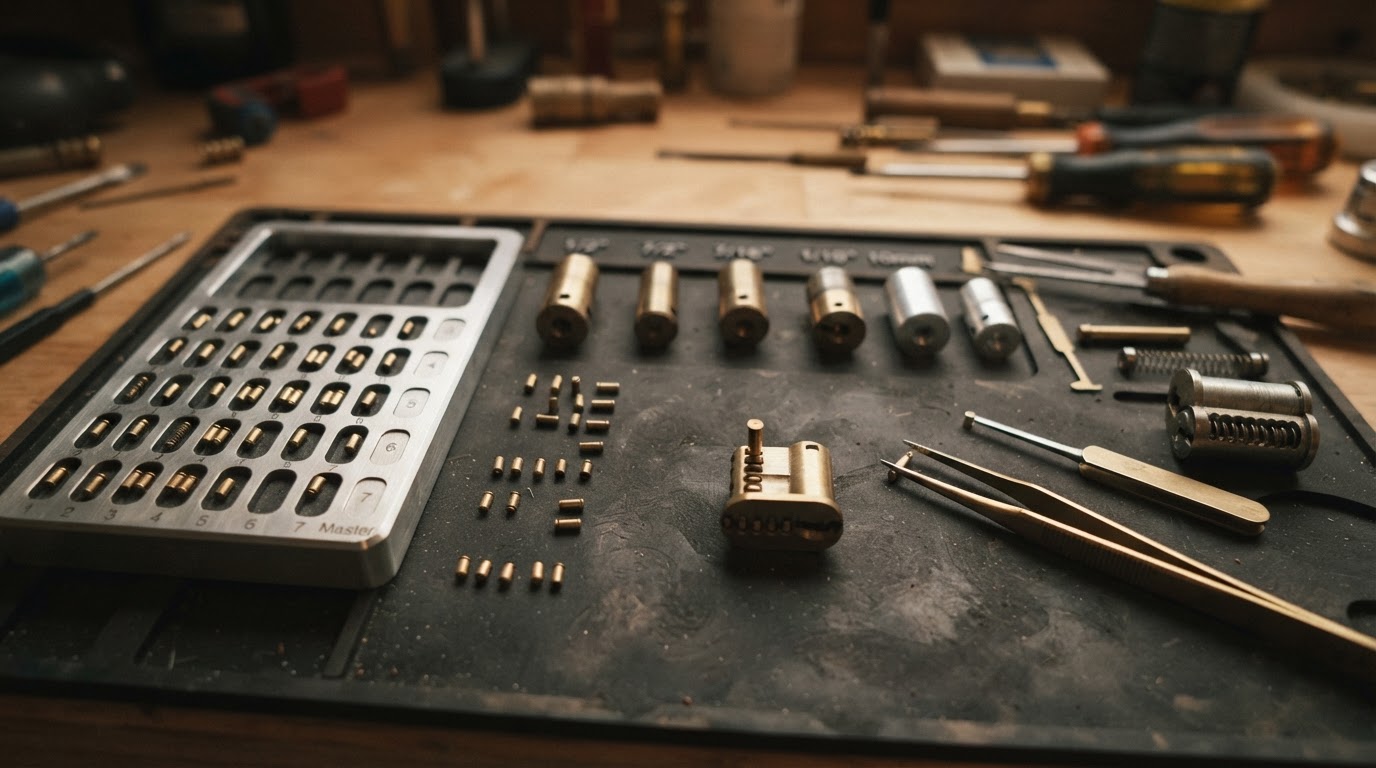
Rekeying changes the internal pin configuration of an existing lock so that a new key is required to operate it. The lock hardware—the cylinder body, bolt, and exterior—remains in place. Only the internal pins and springs are replaced.
- Cost — Generally less expensive than replacement
- Time — Typically faster than replacement
- Hardware — Existing lock is retained
- Security level — Same as the existing lock (no upgrade)
- Key control — Old keys no longer work
#### Replacement
Replacement involves removing the existing lock entirely and installing a new one. The new lock may be the same type or an upgrade.
- Cost — Generally more expensive than rekeying
- Time — Typically takes longer than rekeying
- Hardware — New lock hardware is installed
- Security level — Can upgrade to a higher grade or type
- Key control — Old keys no longer work (new lock uses different key)
When Rekeying Is the Right Choice
Rekeying is appropriate when the existing lock hardware is in good condition and meets your security needs:
#### Moving Into a New Home
When you move into a new home, rekeying is typically the most cost-effective way to establish key control. You don't know how many copies of the existing key are in circulation—previous owners, tenants, contractors, neighbors, or friends may all have copies. Rekeying immediately makes all old keys useless.
If the existing locks are quality hardware in good condition, there's no reason to replace them. Rekeying provides the same key control benefit at a lower cost.
#### Lost or Stolen Keys
If a key is lost or stolen, rekeying ensures the lost key cannot be used. This is more secure than simply hoping the key is found by the right person or ignoring the risk.
If the lost key was a master key in a commercial setting, the entire master key group may need rekeying. A professional can advise on the scope needed.
#### Personnel Changes
For businesses, when employees with key access leave, rekeying ensures they cannot re-enter. This is particularly important for:
- Employees who left on unfavorable terms
- Employees who had access to sensitive areas
- Situations where key return cannot be confirmed
#### Tenant Changes
For rental properties, rekeying between tenants is standard practice. It provides each new tenant with clean key control and protects the property owner from liability.
#### Periodic Security Refresh
Some property owners rekey periodically as a security practice. This limits the number of keys in circulation over time and ensures that keys distributed to contractors, service providers, or temporary users don't remain functional indefinitely.
#### After Lending Keys
If you've lent keys to contractors, house sitters, or service providers and want to ensure they can no longer access your property, rekeying provides peace of mind.
When Replacement Is the Right Choice
Replacement is recommended when the existing hardware is worn, damaged, or no longer meets your security needs:
#### Worn or Damaged Locks
Locks that show signs of wear or damage should be replaced, not rekeyed. Signs include:
- Difficulty turning the key — May indicate worn internal components
- Key sticking — The key gets stuck or is hard to remove
- Visible wear — Scratches, dents, or corrosion on the lock body
- Loose components — The lock feels loose or wobbly
- Latching problems — The bolt doesn't extend or retract smoothly
- Previous break-in attempts — If the lock has been attacked, internal damage may not be visible
Rekeying a worn lock changes the keys but doesn't fix the underlying mechanical issues. A worn lock may fail, stick, or provide reduced security.
#### Security Upgrades
If you want to upgrade your security level, replacement is necessary:
- Higher ANSI grade — Upgrading from Grade 3 to Grade 2 or 1
- High-security locks — Installing locks with restricted keyways, pick resistance, and drill resistance
- Smart locks — Adding electronic access control features
- Different lock type — Changing from a knob lock to a deadbolt, or adding a deadbolt where none exists
Rekeying preserves the existing security level. To improve security, new hardware is needed.
#### Outdated Locks
If your locks are old, outdated, or use obsolete key blanks, replacement is recommended:
- Obsolete key blanks — If key blanks are hard to find, future key duplication becomes problematic
- Discontinued models — If the lock manufacturer has discontinued the model, parts may be unavailable
- Old technology — Older locks may not meet current security standards
- Worn beyond rekeying — If internal components are too worn, rekeying may not produce reliable results
#### After a Break-In
If your property has been broken into, replacement is typically recommended over rekeying:
- Hidden damage — Break-in attempts may cause internal damage not visible externally
- Compromised security — The lock has been proven vulnerable
- Peace of mind — New hardware provides psychological as well as physical security
- Insurance requirements — Some insurance policies require lock replacement after a break-in
A professional assessment can determine whether the existing lock can be rekeyed or needs replacement after a break-in attempt.
#### Building Code Compliance
If your existing locks don't meet current building codes or fire safety requirements, replacement may be necessary:
- Fire-rated doors — Fire doors require fire-rated lock hardware
- ADA compliance — Locks must meet accessibility standards
- Egress requirements — Commercial buildings may require panic hardware or specific lock types
- Local codes — Miami-Dade and Broward counties may have specific requirements
Factors to Consider in Your Decision
#### Lock Condition
The most important factor is the condition of the existing lock:
- Good condition — Rekeying is appropriate
- Worn but functional — Rekeying may work, but replacement provides better long-term value
- Damaged — Replacement is necessary
#### Security Requirements
Consider whether your current security level meets your needs:
- Current level is adequate — Rekeying is appropriate
- Want higher security — Replacement with upgraded hardware
- Want smart lock features — Replacement with electronic lock
#### Budget
Budget considerations:
- Limited budget — Rekeying is more cost-effective
- Moderate budget — Rekeying for most locks, replacement for the most critical
- Adequate budget — Replacement with upgraded hardware throughout
#### Number of Locks
If you have many locks of the same type:
- All same key (keyed alike) — Rekeying or replacement is straightforward
- Different keys — Consider keying all locks alike during rekeying or replacement for convenience
- Master key system — Consult a professional for system-wide planning
#### Property Type
Different property types have different considerations:
- Single-family home — Owner can choose freely; rekeying is common
- Condominium — Check building rules before changing hardware
- Commercial property — Consider master key systems, access control, and code compliance
- Rental property — Rekeying between tenants is standard
The Assessment Process
A professional assessment helps you make the right decision:
#### 1. Discussion
You describe your situation—why you're considering rekeying or replacement, your security concerns, and your budget.
#### 2. Lock Inspection
The technician inspects each lock:
- Visual inspection — Checking for visible wear, damage, or corrosion
- Mechanical test — Testing key operation, bolt extension, and latching
- Security assessment — Evaluating the lock's grade, type, and security features
- Compatibility check — If considering rekeying, confirming the lock can be rekeyed
#### 3. Options Presentation
Based on the assessment, options are presented:
- Rekey — For locks in good condition that meet security needs
- Replace — For worn, damaged, or outdated locks
- Upgrade — For locks where higher security is desired
- Combination — Rekey some locks, replace others, based on condition
Each option includes an explanation of benefits and pricing.
#### 4. Approval
Scope and pricing are presented for approval before any work begins. You choose what work to authorize.
Cost Comparison Examples
While actual costs vary, here's a general comparison:
#### Rekeying a Single Lock
- Labor to remove, disassemble, re-pin, reassemble, and reinstall
- New key pins and springs
- One or more new keys cut
- Generally less expensive than replacement
#### Replacing a Single Lock
- New lock hardware (cost varies by grade and type)
- Labor to remove old lock and install new lock
- New keys (included with new lock)
- Door preparation if the new lock requires different preparations
- Generally more expensive than rekeying
#### Full Home (Multiple Locks)
- Rekeying all — Cost-effective if all locks are in good condition
- Replacing all — More expensive but provides new hardware throughout
- Mixed approach — Rekey good locks, replace worn ones
A professional can provide specific pricing for your situation after an assessment.
Special Considerations
#### Master Key Systems
If your property uses a master key system, rekeying and replacement decisions must account for the system:
- Rekeying within the system — Must maintain the master key hierarchy
- Replacing within the system — New locks must be compatible with the master key system
- System changes — May require rekeying or replacing multiple locks to maintain integrity
#### High-Security Locks
High-security locks with restricted keyways have additional considerations:
- Authorization required — Rekeying requires authorization from the lock manufacturer or dealer
- Specialized key blanks — Only authorized dealers can cut replacement keys
- Cost — High-security lock rekeying and replacement is typically more expensive
- Key control — The restricted keyway provides inherent key control, which is a benefit
#### Smart Locks
Smart locks cannot be "rekeyed" in the traditional sense. Instead:
- Code change — PIN codes can be changed without hardware changes
- Credential management — User access can be added or removed electronically
- Hardware replacement — If the smart lock fails, replacement is necessary
- Battery replacement — Not a rekeying issue, but regular maintenance
Making Your Decision
To decide between rekeying and replacement:
- Assess lock condition — Are the locks in good working order?
- Evaluate security needs — Does the current security level meet your needs?
- Consider budget — What can you afford now and in the near future?
- Think long-term — Will you want to upgrade security in the next few years?
- Get a professional assessment — A locksmith can evaluate your specific situation
Conclusion
The choice between rekeying and replacing depends on the condition of your existing locks, your security needs, and your budget. Rekeying is cost-effective for locks in good condition; replacement is necessary for worn, damaged, or outdated locks or when upgrading security. A professional assessment provides the information you need to make the right choice for your property.
Contact D'Alembert Locksmith to discuss your lock rekeying or replacement needs, current availability, and suitable service options.