Commercial Door Security: Panic Bars and Exit Devices
Panic bars and exit devices are critical life safety hardware for commercial buildings. This guide provides an educational overview of these devices, compliance considerations, maintenance, and what property owners should know about this essential security hardware.
What Are Panic Bars and Exit Devices?
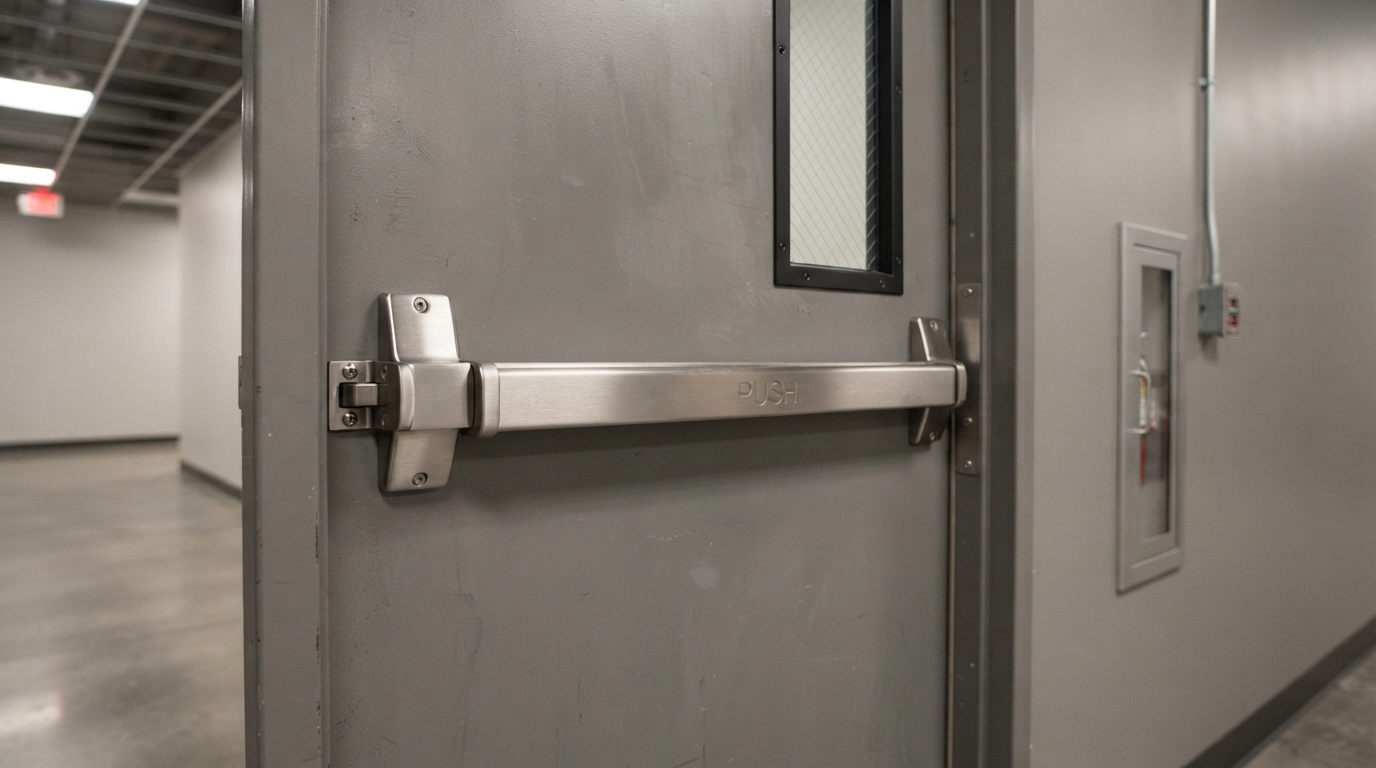
Panic bars—also called crash bars, panic exit devices, or push pads—are hardware devices installed on exit doors that allow the door to be opened by pushing a horizontal bar. This design enables rapid egress in emergency situations, when people may need to exit under stress without fine motor skills to operate a standard door handle.
Exit devices are required by building and fire codes for certain commercial occupancies. They serve a dual purpose: providing reliable emergency egress while maintaining building security when the building is occupied.
Types of Exit Devices
#### Rim Exit Devices
Rim exit devices have the latch on the surface of the door, engaging a strike mounted on the door frame surface. They are the simplest and most common type, suitable for many commercial applications:
- Single doors and narrow stile doors
- Aluminum storefront doors
- Medium-traffic applications
- Relatively easy to install and service
#### Mortise Exit Devices
Mortise exit devices use a mortise lock body installed within a pocket cut into the door. They offer:
- Greater security than rim devices
- Better durability for high-traffic doors
- Additional locking points (deadbolt and latch)
- Suitability for heavy commercial use
Mortise devices are commonly found in hospitals, schools, and other high-traffic institutional buildings.
#### Vertical Rod Exit Devices
Vertical rod exit devices use rods that extend from the device to the top and/or bottom of the door, engaging strikes in the header and floor:
- Surface vertical rod — Rods are mounted on the door surface; easier to install and service
- Concealed vertical rod — Rods are inside the door; more aesthetically pleasing but harder to service
Vertical rod devices are used on double doors and wide doors where a single rim or mortise latch would not provide adequate security. They secure the door at two points (top and bottom), resisting forced entry more effectively.
#### Electrified Exit Devices
Electrified exit devices combine mechanical exit hardware with electronic control:
- Electric latch retraction — Allows remote unlocking for access control integration
- Delayed egress — Provides a timed delay before the door opens (requires code compliance)
- Alarm-equipped — Sounds an alarm when the exit device is activated
- Signal switch — Sends a signal to a monitoring system when the device is used
Electrified devices enable integration with access control, alarm, and building management systems while maintaining life safety egress requirements.
Panic Bar vs. Fire Exit Device: Understanding the Difference
There is an important distinction between panic hardware and fire exit hardware:
#### Panic Hardware (UL 305)
Panic hardware is tested for reliability under panic conditions—ensuring the device operates when people push the bar under stress. It is required in:
- Assembly occupancies (theaters, auditoriums, churches) with 100+ occupants
- Educational occupancies (schools) with 100+ occupants
- Daycare occupancies with 100+ occupants
- Certain retail and mercantile occupancies
Panic hardware can be installed on doors that are not fire-rated.
#### Fire Exit Hardware (UL 10C)
Fire exit hardware must be used on fire-rated doors. Fire exit hardware:
- Meets the panic hardware performance standard (UL 305)
- Additionally meets fire door testing standards (UL 10C)
- Is listed for use on fire doors
- Cannot have mechanical dogging (latch hold-back) features
- Must be self-latching
Fire exit hardware is required on doors that are part of a building's fire compartment—doors that must remain closed and latched during a fire to prevent fire and smoke spread.
#### Dual-Rated Devices
Some exit devices carry both UL 305 (panic) and UL 10C (fire) ratings. These can be used in either application, providing flexibility. However, when installed on a fire door, the fire rating requirements apply (no dogging, self-latching).
Code Compliance Considerations
Building and fire codes specify when and where exit devices are required. Key code considerations include:
#### International Building Code (IBC) and NFPA 101
The IBC and NFPA 101 (Life Safety Code) specify:
- Occupancy type — Different requirements for assembly, educational, mercantile, and other occupancies
- Occupant load — Exit devices are typically required for spaces with 100+ occupants (varies by code and occupancy)
- Door type — Requirements differ for single doors, double doors, and doors with locks
- Egress path — All doors in the egress path must allow free egress when the building is occupied
#### Local Codes
Miami-Dade County and Broward County may have additional requirements:
- Hurricane-related requirements — Wind-borne debris regions may have specific door and hardware requirements
- Fire marshal requirements — Local fire marshals may have specific requirements for certain building types
- ADA requirements — Exit devices must be accessible, with appropriate mounting height and operating force
A professional installer ensures your exit hardware complies with all applicable codes. Non-compliant hardware can result in code violations, fines, and liability in the event of an emergency.
Selecting the Right Exit Device
Choosing the appropriate exit device depends on:
#### Door Type
- Single doors — Rim or mortise exit devices
- Double doors — Vertical rod devices (both leaves) or rim device on active leaf with flush bolts on inactive leaf
- Narrow stile aluminum doors — Rim devices designed for narrow stiles
- Wood doors — Mortise or rim devices depending on door construction
#### Traffic Level
- Low traffic — Standard-duty devices are sufficient
- Medium traffic — Heavy-duty devices provide longer service life
- High traffic — Institutional-grade devices designed for thousands of cycles
#### Security Requirements
- Basic security — Mechanical exit device with cylinder for after-hours locking
- Access control integration — Electrified device with latch retraction
- High security — Electrified device with monitoring and alarm features
#### Fire Rating
- Fire-rated doors — Must use fire exit hardware (UL 10C)
- Non-fire-rated doors — Can use panic hardware (UL 305) or fire exit hardware
Installation Considerations
Professional installation of exit devices involves:
#### Door Preparation
- Mortising — Cutting recesses for mortise devices or strikes
- Drilling — Creating holes for through-bolts, cylinder, and rods
- Reinforcement — Adding reinforcement where needed for secure mounting
- Alignment — Ensuring the device, strike, and door are properly aligned
#### Strike Installation
The strike receives the latch and must be securely mounted:
- Surface strikes — Mounted on the door frame surface
- Mortised strikes — Installed in a pocket cut into the frame
- Floor strikes — For vertical rod devices, mounted in the floor
Proper strike installation is critical for device function and security.
#### Adjustment
After installation, the device must be adjusted for proper operation:
- Latch engagement — The latch must fully engage the strike
- Bar pressure — The operating force must meet code requirements (typically 15 pounds or less)
- Door clearance — The door must have proper clearance for smooth operation
- Rod adjustment — Vertical rods must be properly adjusted for top and bottom engagement
Maintenance and Inspection
Exit devices require regular maintenance to ensure reliable operation:
#### Routine Inspection
- Visual inspection — Check for damage, loose components, and proper alignment
- Operation test — Push the bar to ensure smooth, complete latch release
- Latch engagement — Verify the latch fully engages the strike when the door closes
- Door operation — Ensure the door closes and latches properly
#### Common Issues
- Difficult latching — May indicate misalignment, worn latch, or strike issues
- Sticking bar — May indicate internal wear, debris, or spring failure
- Door not closing properly — May indicate closer adjustment, hinge issues, or frame problems
- Cylinder problems — May indicate worn cylinder, key issues, or internal damage
#### Professional Service
When issues are identified, professional service includes:
- Diagnosis — Identifying the root cause of the problem
- Repair — Adjusting, replacing worn components, or realigning as needed
- Replacement — If the device is beyond repair, replacement options are presented
- Testing — Verifying proper operation after service
Electrified Exit Device Integration
For buildings with access control systems, electrified exit devices provide:
#### Access Control Integration
- Electric latch retraction — The latch retracts when access is granted, allowing entry
- Remote release — Doors can be unlocked from a security desk or remote location
- Scheduled unlocking — Doors unlock automatically at scheduled times
- Emergency release — All doors can be released simultaneously in an emergency
#### Monitoring
- Door position sensors — Indicate whether the door is open or closed
- Latch monitoring — Indicates whether the latch is engaged
- Exit alarm — Sounds when the exit device is used (for controlled areas)
#### Life Safety Compliance
Electrified exit devices must maintain life safety egress:
- Free egress — The push bar must always allow exit, regardless of electronic state
- Fail-safe operation — On power loss, the device must allow egress (may unlock or remain locked depending on code requirements)
- Fire rating — Electrified hardware on fire doors must be listed for fire door use
Factors Affecting Cost
Exit device costs vary based on:
- Device type — Rim, mortise, or vertical rod
- Duty rating — Standard, heavy, or institutional
- Electrification — Mechanical vs. electrified
- Fire rating — Fire exit hardware may cost more than panic hardware
- Door preparation — New doors may need preparation; existing doors may need modification
- Number of doors — More doors mean more hardware and labor
- Brand and quality — Higher-quality devices cost more but last longer
All costs are presented for approval before authorized work begins.
Conclusion
Panic bars and exit devices are essential life safety hardware that protects building occupants while maintaining security. Understanding the types, code requirements, and maintenance needs helps property owners make informed decisions about this critical hardware. Professional installation and regular maintenance ensure reliable operation when it matters most.
Contact D'Alembert Locksmith to discuss commercial exit device needs, current availability, and suitable service options for your Miami-area property.