Commercial Rekeying: Process and Planning
Commercial rekeying is a critical security function for businesses, property managers, and building owners throughout Miami-Dade and Broward counties. This guide explains how commercial rekeying projects are planned and executed, including master key system considerations, scheduling, and what property managers should prepare before authorizing work.
What Is Commercial Rekeying?
Rekeying is the process of changing a lock's internal pin configuration so that a different key is required to operate it. The existing lock hardware remains in place—only the internal pins and springs are replaced. This makes rekeying a cost-effective alternative to full lock replacement when the existing hardware is in good condition.
In commercial settings, rekeying serves several purposes:
- Security after personnel changes — When employees leave, especially those with key access, rekeying ensures old keys no longer work
- Lost or stolen keys — If keys are lost or stolen, rekeying restores key control
- Master key system changes — Reorganizing access hierarchies within a building
- Periodic security refresh — Some businesses rekey on a regular schedule as a security practice
- Tenant changes — When commercial tenants change, rekeying provides clean key control
Master Key Systems in Commercial Settings
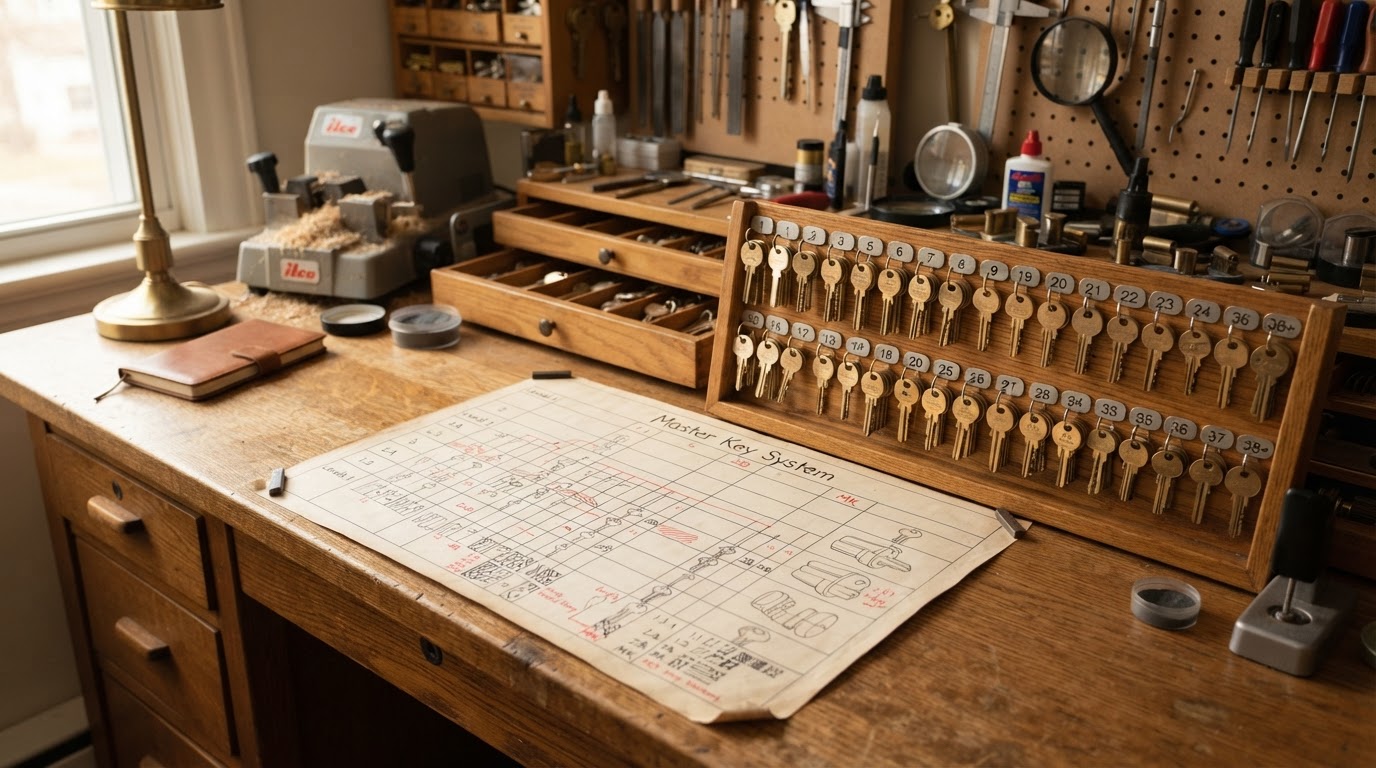
Many commercial properties use master key systems to manage access across multiple doors with different user levels. Understanding how master keying works is essential for planning a rekeying project.
#### How Master Keying Works
A master key system uses a hierarchical key structure:
- Change keys (user keys) — Operate a single lock or a specific group of locks
- Master keys — Operate all locks within a master key group
- Grand master keys — Operate all locks across multiple master key groups (in larger systems)
- Great grand master keys — Operate all locks across multiple grand master groups (in very large systems)
This hierarchy is achieved through specialized pinning within each lock cylinder. Each lock has pins that respond to both the change key and the appropriate master key(s). The complexity of the pinning increases with each level of the hierarchy.
#### Master Key System Planning
Planning a master key system—or modifying an existing one—requires careful consideration:
- Access requirements — Which users need access to which doors
- Hierarchy structure — How many levels of keys are needed
- Future expansion — Planning for additional doors or user groups
- Key control — How keys are distributed, tracked, and recovered
- Lock compatibility — Not all locks can be master keyed; some brands and models have limitations
A professional locksmith can design a master key system tailored to your building's layout and access requirements. The system should be documented so that future changes can be made without compromising the existing hierarchy.
#### Modifying an Existing Master Key System
If your building already has a master key system, rekeying must account for the existing hierarchy. Changes to one lock may affect the master key's ability to operate it. A professional with knowledge of the system's pinning chart is essential for maintaining system integrity during modifications.
If the existing system's documentation is unavailable, a locksmith can reverse-engineer the system by examining the lock cylinders and keys. This adds time to the project but is necessary for maintaining system integrity.
Planning a Commercial Rekeying Project
#### Step 1: Identify the Scope
Before contacting a locksmith, identify:
- Which locks need rekeying — All locks, specific floors, or individual doors
- Why rekeying is needed — Personnel change, lost key, system reorganization
- Key distribution plan — Who will receive new keys and how many
- Timeline — When the rekeying needs to be completed
- Access during the project — How building access will be managed while locks are being changed
#### Step 2: Property Assessment
A professional assessment includes:
- Lock inventory — Identifying all locks, their types, brands, and models
- Condition assessment — Determining which locks can be rekeyed and which need replacement
- Master key system review — If a master key system exists, reviewing its structure and documentation
- Key blank identification — Determining the correct key blanks for the new keys
- Access planning — Coordinating the project to minimize disruption to building operations
#### Step 3: Scheduling Considerations
Commercial rekeying projects require careful scheduling:
- Business hours vs. after hours — Some businesses prefer rekeying during off-hours to minimize disruption
- Tenant coordination — In multi-tenant buildings, coordinating access with all affected tenants
- Staged approach — For large buildings, rekeying may be done in stages over multiple visits
- Key distribution timing — New keys should be distributed before or immediately after rekeying to avoid access issues
Service requests are handled according to current availability. A technician can discuss scheduling options and provide an estimated timeline for the project.
#### Step 4: Authorization and Verification
Commercial rekeying requires proper authorization:
- Property ownership verification — The locksmith must verify that the person requesting rekeying is authorized to do so
- Building management authorization — In leased properties, both the property owner and tenant may need to authorize the work
- Key control documentation — Records of who received new keys should be maintained
What Property Managers Should Prepare
If you are a property manager planning a commercial rekeying project, having the following information ready streamlines the process:
#### Information to Prepare
- Complete lock inventory — A list of all doors with locks, including door locations and lock types
- Existing key information — How many keys are currently in circulation and who holds them
- Master key system documentation — If available, the pinning chart and key hierarchy documentation
- New access plan — Who will receive new keys and at what level (change key, master key, etc.)
- Building access — Arranging for the technician to access all lock locations
- Authorization documentation — Proof of authorization to request the rekeying
#### During the Project
- Designate a point of contact — Someone who can answer questions and make decisions during the project
- Plan for key distribution — Have a system ready for distributing new keys to authorized personnel
- Collect old keys — Retrieve old keys from all key holders before or during the rekeying
- Test new keys — After rekeying, test all new keys in all rekeyed locks to confirm proper operation
Rekeying vs. Lock Replacement
During the assessment, some locks may be identified as needing replacement rather than rekeying:
#### When Rekeying Is Appropriate
- The lock hardware is in good mechanical condition
- The lock brand and model support the desired key system
- The lock's security level meets current requirements
- The lock is compatible with the building's master key system (if applicable)
#### When Replacement Is Recommended
- The lock is worn, damaged, or malfunctioning
- The lock brand is discontinued or uses obsolete key blanks
- A higher security grade is needed
- The lock cannot be master keyed to the desired system
- The lock has been compromised (drilled, picked, or forced)
A professional assessment identifies which locks can be rekeyed and which should be replaced, with options and pricing presented for approval before any work begins.
Factors Affecting Cost and Timeline
Commercial rekeying costs vary based on:
- Number of locks — More locks mean more time and materials
- Lock type and complexity — High-security locks and complex master key systems require more time per lock
- Master key system design — Designing or modifying a master key hierarchy adds planning time
- Key quantities — More keys to cut means more time
- Lock condition — Locks needing repair before rekeying add time
- Scheduling — After-hours or weekend service may have different scheduling considerations
- Access conditions — Difficult-to-access locks or locations add time
All costs are presented for approval before authorized work begins.
Post-Rekeying Best Practices
After a commercial rekeying project is completed:
- Document the new key system — Maintain records of the key hierarchy, pinning chart, and key distribution
- Implement key control policies — Establish procedures for key issuance, return, and tracking
- Secure master keys — Store master and grand master keys securely with limited access
- Plan for future changes — Keep system documentation updated as changes are made
- Schedule periodic reviews — Periodically assess whether the key system meets current security needs
Common Commercial Rekeying Scenarios
#### Employee Turnover
When an employee with key access leaves, rekeying the locks they had access to ensures they cannot re-enter. If the departing employee held a master key, the entire system may need rekeying. Having a key control policy that requires key return at termination reduces the frequency of rekeying needs.
#### Lost or Stolen Keys
If a key is lost or stolen, the affected lock(s) should be rekeyed promptly. If the lost key was a master key, the entire master key group must be rekeyed. Maintaining key control—knowing who has which keys—helps identify the scope of rekeying needed.
#### Tenant Changes
When a commercial tenant moves out, rekeying their space provides clean key control for the next tenant. This should be part of the standard tenant turnover process.
#### Security Incidents
After a security incident—break-in, attempted entry, or suspicious activity—rekeying may be part of the security response. A full assessment of the property's security should accompany the rekeying to identify any other vulnerabilities.
Conclusion
Commercial rekeying is a vital security function that requires careful planning, proper authorization, and professional execution. By understanding the process and preparing the necessary information, property managers and business owners can ensure their rekeying project is completed efficiently and effectively.
Contact D'Alembert Locksmith to discuss commercial rekeying needs, current availability, and suitable service options for your Miami-area property.