What to Expect When Requesting Locksmith Service
Understanding the locksmith service process helps you prepare, know what to expect, and ensure a smooth experience. This guide walks through the entire process—from initial contact through job completion—so you know what to have ready, how assessments work, and what happens during a service visit.
Step 1: Initial Contact
The service process begins when you contact the locksmith. Whether you call, submit an online request, or send a message, the initial contact is where you describe your need and the locksmith gathers basic information.
#### What to Have Ready
When you call, having the following information ready helps the locksmith prepare:
For residential service:- Your address or location
- The type of lock or door involved (if known)
- A brief description of the problem or need
- Whether you have any working keys
- Any access considerations (gated community, apartment building, parking)
- Business name and address
- The type of lock or system involved
- Number of doors or locks affected
- Whether it's a scheduled service or an immediate need
- Building access information (after-hours access, loading dock, etc.)
- Your location
- Vehicle make, model, and year
- A description of the situation (lockout, key won't turn, need spare key)
- Vehicle identification number (VIN) if available
- Proof of ownership (registration, insurance, title)
- Your contact information (name, phone number)
- Preferred contact method
- Any time constraints or scheduling preferences
#### What Happens During the Call
The locksmith will:
- Listen to your situation — Understand what you need and the circumstances
- Ask clarifying questions — Gather details needed to prepare for the service
- Discuss current availability — Explain when a technician can assist based on current workload
- Provide general information — Answer questions about the service, process, and what to expect
- Discuss scheduling — Arrange a time for the service based on availability
- Confirm your information — Verify your location, contact information, and the service needed
#### What the Locksmith Will Not Promise
During the initial contact, the locksmith will not:
- Promise a specific arrival time — Availability and arrival estimates vary according to location, traffic, weather, job conditions, and technician workload
- Guarantee a specific outcome — Outcomes depend on the lock condition, age, previous work, and site-specific factors
- Provide exact pricing without assessment — Accurate pricing requires assessing the specific situation
- Promise specific response or dispatch times — Service requests are handled according to current availability
Step 2: We Review the Request
After the initial contact, the locksmith reviews the request and prepares for the service:
#### Request Review
- Service type — Confirming the type of service needed
- Equipment preparation — Ensuring the technician has the right tools and hardware
- Scheduling — Assigning the service based on current availability
- Technician assignment — Matching the right technician to the job based on expertise
#### Communication
- Confirmation — You may receive a confirmation of the service request
- Updates — If there are any changes to scheduling, you'll be notified
- Questions — If additional information is needed, the locksmith may contact you
Step 3: On-Site Assessment
When the technician arrives, the assessment process begins:
#### Identity and Authorization Verification
Before any work begins, the technician verifies:
- Your identity — Confirming you are the person who requested service
- Property authorization — For residential and commercial service, confirming you are authorized to request service for the property
- Vehicle ownership — For automotive service, verifying vehicle ownership through registration, insurance, or title
This verification is standard practice and protects against unauthorized access to properties and vehicles.
#### Situation Assessment
The technician assesses the specific situation:
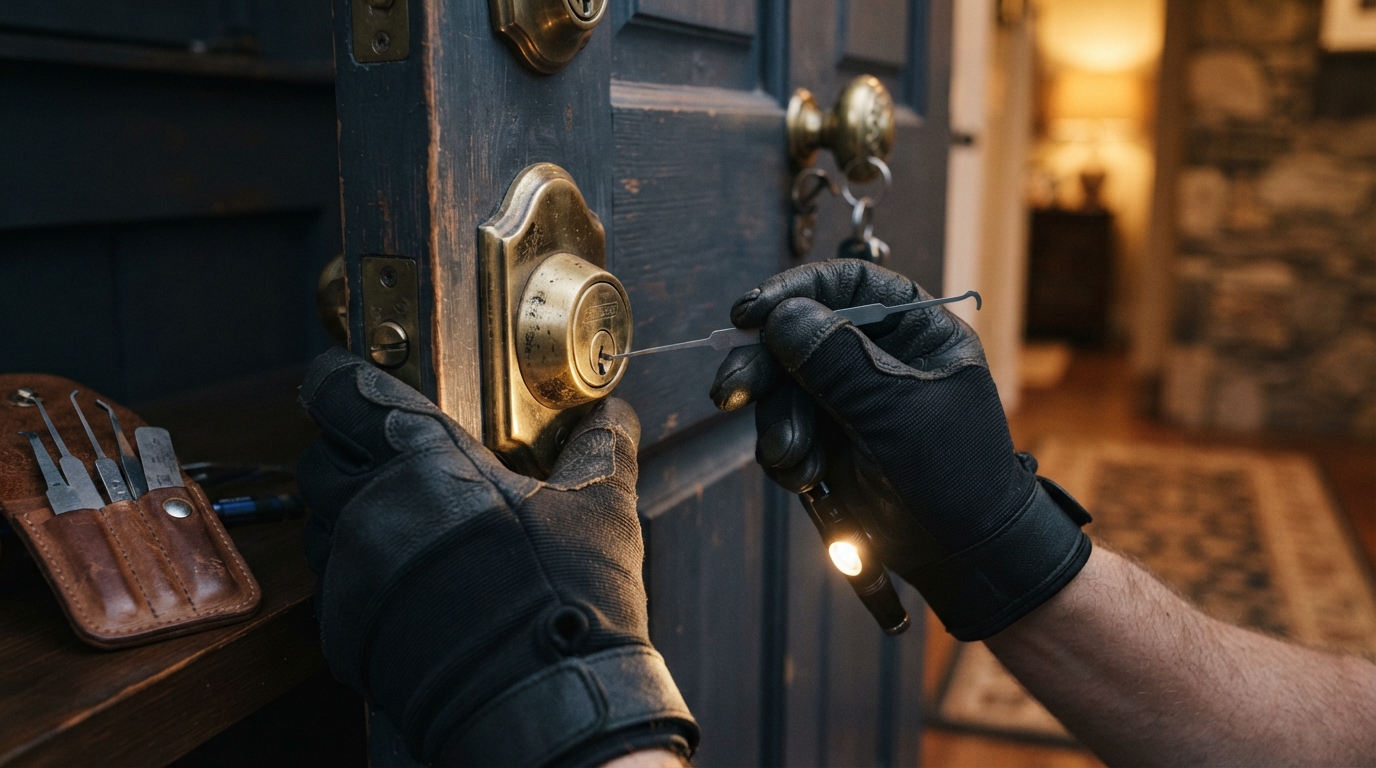
For lock problems:- Visual inspection — Examining the lock, door, and frame for visible issues
- Operational test — Testing the lock to identify the specific problem
- Internal inspection — If needed, removing the lock cylinder to inspect internal components
- Condition assessment — Evaluating the overall condition of the hardware
- Door measurement — Measuring door thickness, backset, and bore hole size
- Hardware assessment — Evaluating existing hardware and compatibility
- Frame inspection — Checking the door frame condition
- Security assessment — Recommending appropriate hardware for the application
- Vehicle identification — Confirming the exact make, model, and year
- Key assessment — If you have a key, examining its condition
- Lock assessment — If applicable, examining the lock or ignition
- Programming assessment — Determining what programming is needed
#### Options Presentation
Based on the assessment, the technician presents options:
- What was found — Explaining the problem or situation
- Available options — Presenting suitable solutions with explanations
- Trade-offs — Explaining the benefits and limitations of each option
- Pricing — Presenting the cost for each option
This is your opportunity to ask questions, understand the options, and make an informed decision.
Step 4: Approval
Before any work begins, the technician presents the scope and pricing for your approval:
#### What Is Presented
- Scope of work — Exactly what will be done
- Hardware — What hardware will be used (if applicable)
- Timeline — How long the work is expected to take
- Cost — The total price for the work
- Warranty — Any warranty on the work (if applicable)
- Expectations — What to expect during and after the work
#### Your Decision
You decide:
- Approve — Authorize the work to proceed
- Modify — Request changes to the scope
- Decline — Choose not to proceed (you may still be responsible for a service call charge, which would have been discussed during the initial call)
No work begins without your approval. This ensures you understand and agree to what will be done and what it will cost.
Step 5: Work Execution
Once you approve, the technician performs the work:
#### Professional Standards
- Care for property — Protecting doors, frames, finishes, and surrounding areas
- Proper techniques — Using appropriate methods and tools
- Quality hardware — Using appropriate hardware for the application
- Clean work area — Keeping the work area clean and organized
#### Communication During Work
- Progress updates — Keeping you informed of progress
- Unexpected findings — If additional issues are discovered, explaining them before proceeding
- Questions — Answering any questions you have during the process
#### Types of Work
Lock repair:- Disassembly, cleaning, component replacement, reassembly, testing
- Hardware removal, door preparation, new hardware installation, testing
- Cylinder removal, disassembly, pin replacement, reassembly, testing, key cutting
- Key cutting, transponder programming, remote programming, testing
- Wiring, hardware installation, software configuration, testing, training
Step 6: Completion and Review
After the work is completed, the technician reviews it with you:
#### Work Review
- What was done — Explaining the completed work
- Operation demonstration — Demonstrating that the work functions correctly
- Key/hardware handover — Providing keys, remotes, or other hardware
- Documentation — Providing any documentation (warranty, instructions, etc.)
#### Final Inspection
- Your inspection — You inspect the work and confirm satisfaction
- Testing — You test the work (try the key, operate the lock, etc.)
- Questions — Any final questions are answered
#### Payment
- Invoice — You receive an invoice for the completed work
- Payment — Payment is collected according to the agreed terms
- Receipt — You receive a receipt for payment
#### Post-Service Information
- Maintenance tips — How to maintain the hardware
- Warranty information — What warranty applies and how to use it
- Follow-up — When to schedule follow-up or maintenance service
Understanding Pricing
#### How Pricing Works
Locksmith pricing varies according to:
- Service requested — Different services have different labor and material costs
- Lock and hardware type — Higher-grade and specialized hardware costs more
- Vehicle or property details — Luxury vehicles and complex properties may require more time
- Condition and complexity — Worn or damaged hardware, unusual configurations
- Replacement parts — The cost of hardware, keys, or other parts
- Access conditions — Difficult access or unusual situations
- Time and scheduling — Service during normal business hours vs. after-hours
- Additional damage — Issues discovered during inspection that weren't initially apparent
#### Why Pricing Is Presented After Assessment
Accurate pricing requires assessing the specific situation:
- Lock condition — Can't be determined without inspection
- Hardware compatibility — Must be verified on-site
- Access conditions — May affect the time and method
- Hidden issues — May not be apparent until the lock is opened
A phone discussion provides general information, but final pricing is presented after the on-site assessment and before any authorized work begins.
What to Do After Service
#### Test the Work
- Test all keys — Make sure all keys work smoothly
- Test all locks — Lock and unlock all serviced locks
- Test all functions — For smart locks or access control, test all functions
- Test immediately — Test before the technician leaves so issues can be addressed
#### Keep Documentation
- Save the invoice — For warranty and tax purposes
- Save warranty information — Know what's covered and for how long
- Save key information — Key codes or system documentation (if applicable)
- Note the service — Record what was done for future reference
#### Maintenance
- Follow maintenance recommendations — Lubricate locks, test operation periodically
- Address issues early — Don't wait for problems to worsen
- Schedule maintenance — For commercial properties, consider a maintenance plan
Preparing for Future Service
To make future service easier:
- Keep spare keys — Store spare keys in a secure location
- Document your hardware — Know what locks and systems you have
- Maintain records — Keep service records and warranty information
- Schedule maintenance — Regular maintenance prevents emergencies
- Have contact information — Keep the locksmith's contact information accessible
Conclusion
Understanding the locksmith service process helps you prepare, know what to expect, and ensure a smooth experience. From initial contact through job completion, each step is designed to provide clear communication, professional service, and work that meets your needs. Having the right information ready and knowing what to expect makes the process faster and more efficient.
Contact D'Alembert Locksmith to discuss your service needs, current availability, and suitable service options.